Oil's Tanking, Gold's Dead—China's Internet Is Spiraling
Here's a riddle that's melting brains across Chinese social media right now: oil prices are falling, which should mean good news, right? Except gold—the traditional panic button asset—isn't budging either. So what exactly is the market terrified of?
That headline, 「油价跌了黄金也没涨 市场在担心什么」, has exploded on Toutiao (今日头条) with over 543,000 engagements, and it's touching a raw nerve because it confirms what every ordinary Chinese person with a savings account already feels in their bones: something's off, and nobody can name it.

Let's break down why this seemingly boring commodities story has become the financial equivalent of a horror film on the Chinese internet.
The Oil-Gold Paradox, Explained for Normies
Here's the conventional playbook: when oil drops, it signals weakening demand, which spooks investors into buying gold as a safe haven. Gold goes up. Simple因果关系 (cause-and-effect) that every financial influencer on Douyin (抖音) has been preaching for years.
Except that's not happening. Both are just... sitting there. Like that awkward silence at a family dinner when everyone knows something's wrong but nobody wants to be the first to say it.
On Weibo (微博), user @财经老司机 posted: "Oil down, gold flat. This isn't a market, it's a crime scene where nobody's called the police yet." It got 12,000 likes in two hours.
Why Chinese Netizens Especially Care
Here's the thing about Chinese retail investors—they're obsessed with tangible assets. Unlike their American counterparts who'll YOLO into meme stocks, your average Chinese middle-class family treats gold like a religion. Wedding gold? Mandatory. Gold bracelets for newborns? Non-negotiable. Chongqing grandma buying 100g gold bars at the bank like they're on sale? Standard Tuesday.
China and India together account for roughly half of global physical gold demand. When Chinese consumers stop buying—even temporarily—it's not just a market blip, it's a cultural semaphore.
The oil question hits differently too. China's the world's largest oil importer. Cheaper oil should be a windfall for Chinese manufacturing and logistics. But on Xiaohongshu (小红书), posts about "why aren't things getting cheaper even though oil dropped" are proliferating. One viral post from a small business owner in Yiwu showed her shipping costs increasing despite lower crude prices. "The savings aren't reaching us," she wrote. "Someone's pocketing the difference."
The Real Fear: Deflation with Chinese Characteristics
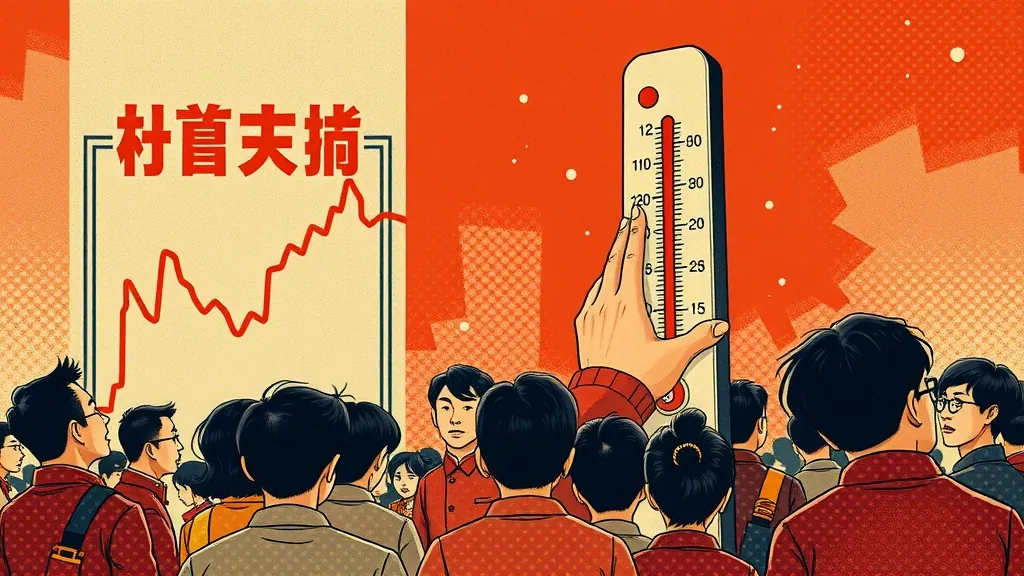
What the Toutiao headline is really dancing around—and what commentators on Bilibili (B站) economics channels are discussing in increasingly alarmed tones—is deflationary anxiety.
When both commodities go limp simultaneously, it often signals that liquidity is trapped. Money exists but isn't moving. People are saving, not spending. Businesses are surviving, not expanding.
Sound familiar? It should. Chinese consumer price indices have been flirting with deflationary territory for months. Pinduoduo (拼多多), the discount e-commerce giant, reported surging growth precisely because consumers are trading down aggressively. Pop Mart (泡泡玛特) might be having a Labubu moment, but that's aspirational spending by a narrow demographic—the broader picture is your average Chinese family in Zhengzhou or Mianyang looking at their WeChat Pay balance and thinking, "Maybe I don't need that hotpot tonight."
Meituan (美团) delivery drivers in second-tier cities have been posting on Douyin about declining order volumes. "Last year I'd get 40 orders a day minimum," one rider in Chengdu said. "Now I'm lucky to hit 25. People are cooking at home."
The Psychology of «不知道» ("Don't Know")
What makes this trending topic so resonant is the ambiguity. The headline doesn't claim to have answers—it's literally asking "what is the market worried about?" That open-endedness is catnip for Chinese internet discourse.
On Zhihu (知乎), the long-form answer platform, one economics PhD candidate wrote a 4,000-word analysis that concluded with: "The most dangerous kind of uncertainty is the kind you can't articulate. We're not in a crisis. We're in a vibe, and the vibe is bad."
That post got shared over 8,000 times.
What This Means for the China-Watching Crowd
If you're tracking Chinese consumer sentiment for business or investment purposes, this oil-gold double flatline is your canary in the coal mine. Not because of what it says about global commodities, but because of what it reveals about Chinese psychology right now.
The post-pandemic rebound that Western analysts kept predicting? It happened, but it happened selectively. Luxury spending recovered. Domestic tourism exploded during holidays. But everyday consumption—random shopping, mid-range dining, impulse purchases—remains sluggish.
Tencent (腾讯) reported that WeChat mini-program transaction growth has decelerated. Not reversed, but slowed enough that it spooked analysts in Hong Kong.
The Chinese internet is often dismissed in Western coverage as either propaganda or entertainment. But moments like this—when a simple commodities observation becomes a collective anxiety dump—reveal something more complex. This is a society where financial literacy is rapidly increasing (thanks to countless fintfluencers on Douyin and Bilibili), but where the gap between knowing and feeling economic conditions has never been wider.
People know the numbers aren't terrible. They feel like something's wrong anyway.
And when 543,000 people engage with a headline that essentially says "we can't explain why everything feels weird," you're not looking at market analysis. You're looking at collective intuition.
The market's worried about something? Maybe. Or maybe 1.4 billion people are just tired of being told things are fine when their grocery bills and paychecks tell a different story.
That's not a market trend. That's a mood. And moods, as any Chinese fortune teller will tell you, are harder to predict than any commodity price.